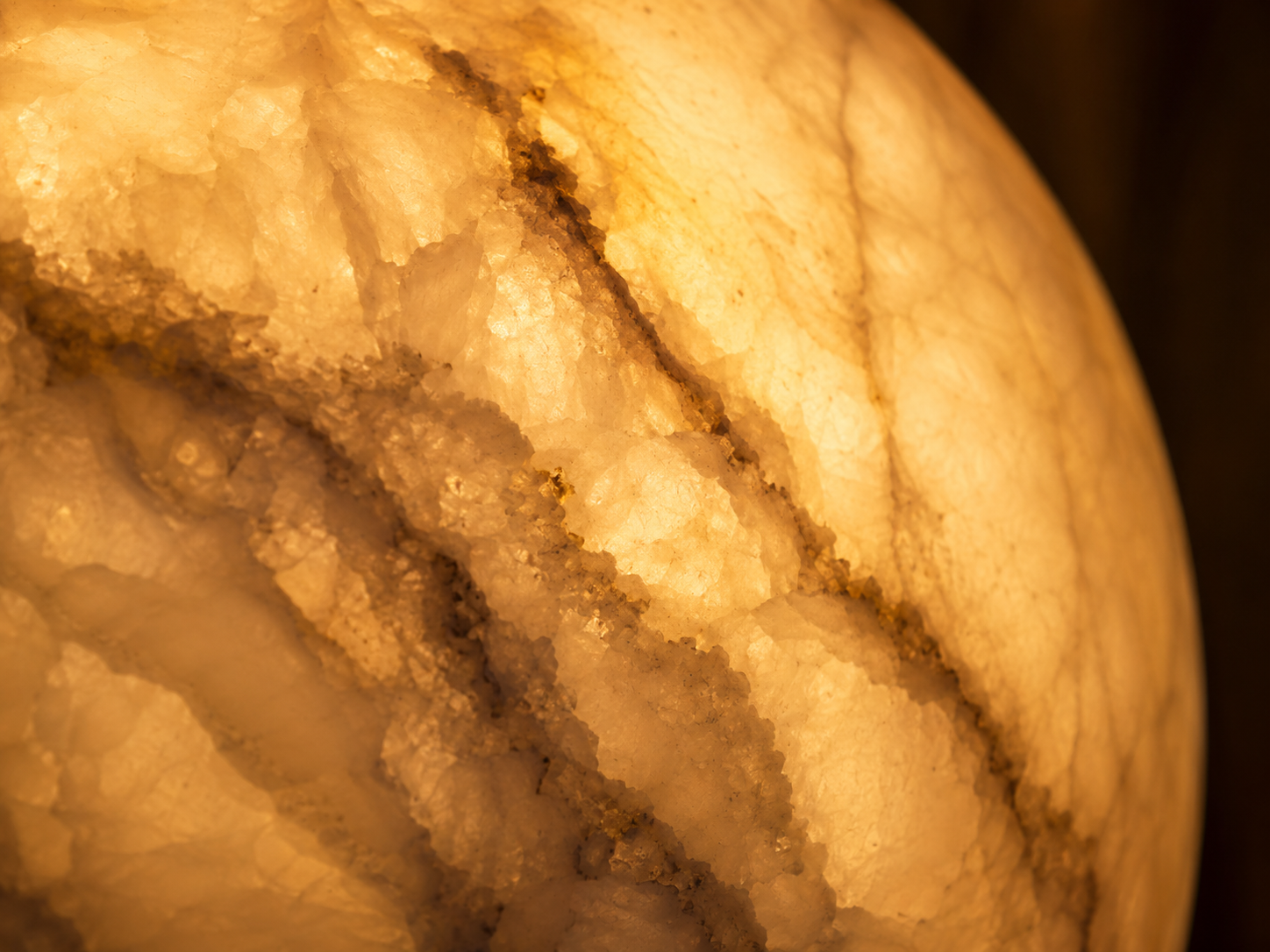

Kitchen island lighting works to three measurements: hang the bottom of each pendant 30 to 36 inches above the countertop, space multiple pendants 24 to 30 inches apart center to center, and keep the outermost fixtures at least 6 inches inside each end of the island. Most islands take two or three pendants — a 6 ft island takes two, a 9 ft island takes three — or a single linear fixture running roughly half the island's length. This guide covers the exact numbers for islands from 4 ft to 12 ft, how to pick between alabaster, brass, glass, acrylic, and crystal, and which fixtures use replaceable bulbs.

How Many Pendants Over a Kitchen Island?
Island length decides the count. Measure the island's long side, then work from this table:
Two sizing limits keep the arrangement from overwhelming the island. Keep the combined width of all fixtures under half the island's length — three 20-inch pendants total 60 inches, which suits a 10 ft island but crowds an 8 ft one. And keep each pendant no wider than one-third of the island's depth, so a standard 40-inch-deep island takes pendants up to roughly 13 inches for a tight look, or up to 24 inches when the pendant is the room's deliberate focal point.
Odd numbers read as intentional at small sizes: a row of three mini pendants looks composed, while three large domes usually looks crowded. Browse the full range in .
How High to Hang Pendants Over an Island
Measure from the countertop to the bottom of the fixture, not to the ceiling canopy. The working range is 30 to 36 inches, and three factors move you within it:
- Standard 8 ft ceiling — hang at 30 to 32 inches. This clears sightlines across the island while keeping light close to the work surface.
- 9 ft or 10 ft ceiling — hang at 32 to 36 inches, and add roughly 3 inches of height for each additional foot of ceiling above 8 ft.
- Sightline check — sit at the island and look across it. If the fixture blocks the face of the person opposite, raise it 2 inches at a time until it clears.
Tall fixtures need their own drop checked against the ceiling. The stands 30 inches tall and the drops 39.3 inches from the canopy — on an 8 ft ceiling, confirm the adjustable cable or rod can be shortened before ordering. For ceiling-height math across the whole home, see the .

Spacing and Layout: The Five-Step Method
Run these five steps with a tape measure before drilling anything:
- Measure the island's full length in inches — for example, 96 inches (8 ft).
- Subtract 12 inches for the 6-inch clearance at each end: 96 − 12 = 84 inches of usable span.
- Divide by the number of pendants to find each fixture's zone: 84 ÷ 2 = 42 inches, so pendant centers sit 42 inches apart, comfortably inside the 24–30 inch minimum for adjacent fixtures.
- Mark centers from the island's midpoint, working outward symmetrically rather than measuring from one end — this keeps the row centered even if the island is slightly off-square.
- Check against the range hood and upper cabinets, leaving at least 6 inches of visual gap so fixtures do not appear to collide from across the room.
For a single linear fixture, center it on the island and choose a length of roughly half to two-thirds the island: an 8 ft island suits the 25.5-inch ; a 5 ft island suits a 15.7-inch fixture.
Choosing the Material
Material decides the quality of light as much as the look. Islands are work surfaces, so glare control matters more here than in a dining room.
| Material | Light quality | Suits | Example |
|---|---|---|---|
| Alabaster | Diffuses through natural stone; warm, low-glare, unique veining | Organic modern, quiet luxury | Kova 7", Bosso 4.7"/5.9" |
| Brass | Reflects and bounces light; opaque shade directs it downward | Mid-century, warm traditional | Voryn 24", Oralis 18" |
| Frosted acrylic | Even, glare-free wash across the whole surface | Scandinavian, minimalist | Diskos 15.7"–23.6" |
| Painted metal | Directional task light, sharp shadow edges | Contemporary, industrial | Foglia, black or white |
| Colored glass | Textured, scattered glow; adds color accent | Eclectic, characterful | Piedra 7.1"/8.7" |
| Crystal | Refracts into sparkle rather than diffusing | Glam, formal open-plan kitchens | Cristal mini 3.1" |
Two practical notes. Opaque shades like the put more light on the counter and less in your eyes, which suits islands used for food prep. Translucent shades like glow across their whole surface, which suits islands that double as gathering or serving space — the tradeoff is explained further in the .
Bulbs, Color Temperature, and Dimming
Check whether a fixture uses replaceable bulbs or an integrated LED before buying — integrated LEDs cannot be swapped when they eventually fail, while socketed fixtures accept any compatible bulb.
- Replaceable sockets: Kova (E27), Oralis (two E26), Bosso (G9), Piedra (ships without bulb)
- Integrated LED: Diskos (15W/1,650 lm at 15.7", 18W at 19.7", 27W at 23.6"), Foglia, Reiko, Aitu (80W)
Warm white at 3000K is the default across the Esperilux island range and suits most kitchens. Cool white at 6000K is available on Diskos, Foglia, Reiko, and Aitu for kitchens used mainly for task work; Reiko adds a 4000K neutral option. The includes remote and app dimming with adjustable color temperature, letting one fixture shift from bright prep light to a warm evening setting. For choosing between temperatures, see .

Pendants or a Chandelier?
A pendant hangs a single shade from one cord or stem; a chandelier branches into multiple arms or tiers from one central body. Islands take pendants in most kitchens because a row of small fixtures distributes light evenly along a long, narrow surface. A chandelier suits an island when the kitchen is open-plan and the island functions as the room's centerpiece rather than a prep station — see for that approach, and for the full comparison.
Kitchen Island Lighting FAQ
How many pendants should I hang over a kitchen island?
Two pendants suit islands from 4 to 8 feet, and three suit islands from 8 to 10 feet. Keep the combined width of all fixtures under half the island's length, and leave at least 6 inches between the outermost fixture and each end of the island.
How high should pendants hang above a kitchen island?
Hang the bottom of each pendant 30 to 36 inches above the countertop. Use 30 to 32 inches on a standard 8 ft ceiling, and add roughly 3 inches for each additional foot of ceiling height.
Should kitchen island pendants match the dining room chandelier?
Matching finishes matters more than matching shapes. Pendants and a chandelier in the same metal finish and the same color temperature read as a coordinated scheme even when their silhouettes differ, which is preferable to installing identical fixtures in both spaces.
Do kitchen island pendants come with bulbs?
It depends on the fixture. Integrated LED models such as the Diskos, Foglia, Reiko, and Aitu include their light source. Socketed models such as the Kova (E27), Oralis (E26), and Bosso (G9) take standard replaceable bulbs, and the Piedra ships without a bulb.