
A staircase chandelier should be one-third to one-half the width of the stairwell opening, and its lowest point must stay at least 7 feet above every stair tread and landing beneath it. In a two-story stairwell, choose a cascading or spiral design whose total height fills 50 to 70 percent of the vertical space between the second-floor ceiling and the 7-foot clearance line. This guide explains each measurement step by step.

How to Size a Staircase Chandelier
Diameter. Measure the stairwell opening (the open void the fixture hangs in). The chandelier should span one-third to one-half of that opening's width. A 6-foot-wide stairwell void suits a fixture 24 to 36 inches across.
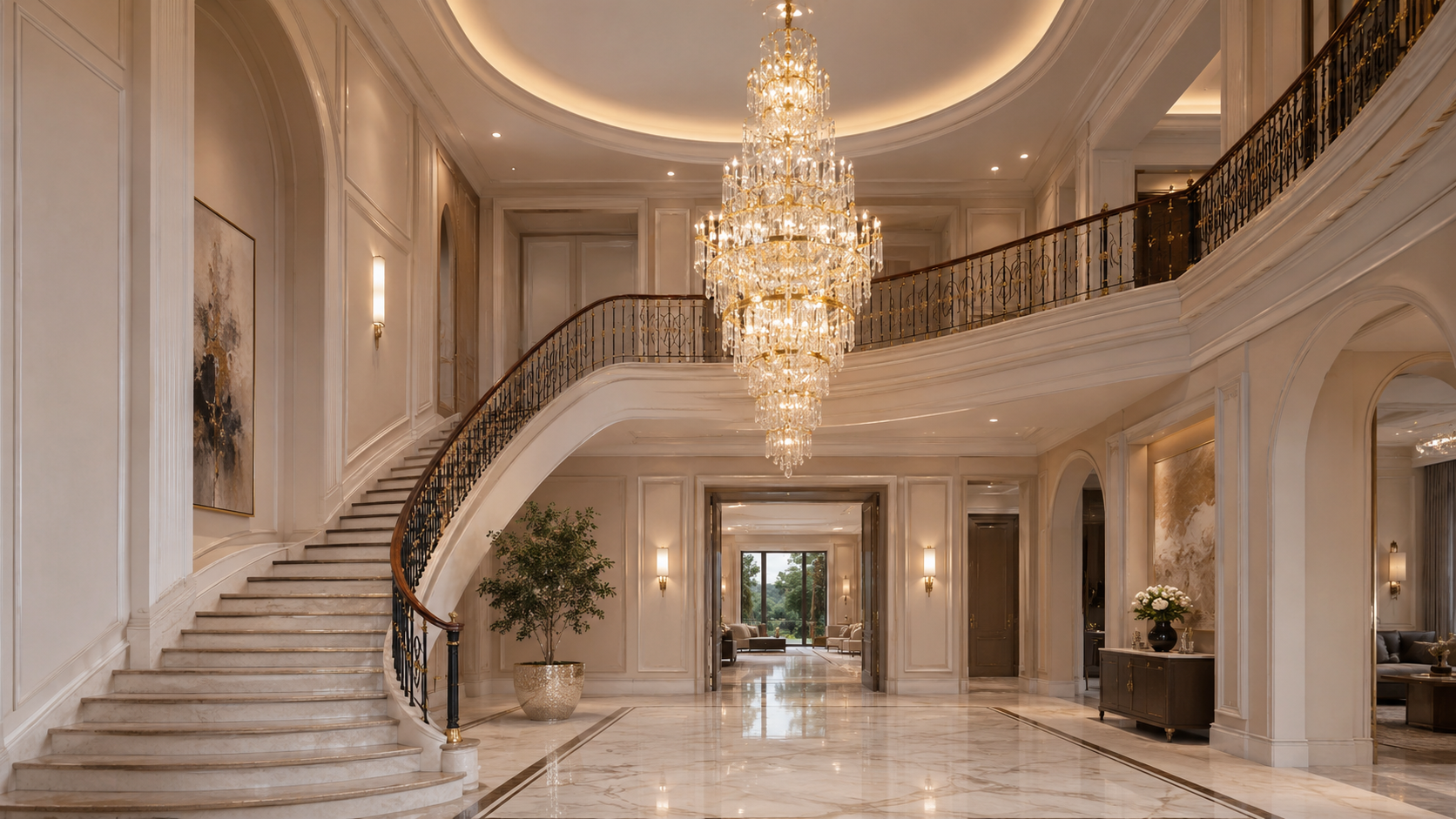
Vertical height — the rule most people miss. A stairwell is a vertical room. Measure from the second-floor ceiling down to the 7-foot clearance line above the highest tread below the fixture; the chandelier's own height should fill 50 to 70 percent of that distance.
| Stairwell type | Ceiling height | Suggested fixture height |
|---|---|---|
| Single-story stair | 9–10 ft | 20–30 in |
| Two-story stairwell | 18–20 ft | 50–90 in (multi-tier) |
| Grand/triple height | 24 ft+ | 90 in+ or custom drop |
For the diameter rules of every other room, see the .

Drop Length and Clearance: Getting the Height Right
- 7-foot rule, applied to stairs. Measure from the highest tread or landing under the fixture, not the ground floor. People climb toward the chandelier.
- Sightline from the top floor. Stand at the top landing: the chandelier's top tier should hang at or below your eye level from that position, so the fixture reads as a sculpture in the void rather than an obstacle.
- Centering. For a straight stairwell, center the fixture in the void. For a curved staircase, hang it at the visual center of the curve, where it is visible from the front door if possible.

Spiral, Cascading, and Tiered: Which Design Fits
Spiral chandeliers wind crystals around a vertical axis and suit modern and transitional homes. Our is built exactly for double-height stairwells.
Cascading (raindrop) designs fall straight down like a column of crystal and work in both classic and contemporary stairwells.
Stacked tiered designs carry the most traditional presence. Browse the full , or for openings beside the stairs, consider a .
All Esperilux staircase fixtures use K9 crystal; read for the material comparison.

Installation: Plan Before You Order
- Weight. Multi-tier staircase chandeliers run 80 to 200+ lbs (36–90 kg). The mount must anchor into ceiling structure, never drywall alone — this is non-negotiable at this weight class.
- Chain and wire length. Order the drop length calculated above plus 10 percent margin; extending after delivery is the most common and most avoidable delay.
- Access for cleaning. In a stairwell, plan how the fixture will be reached later: a winch/lift system is worth specifying for fixtures above 15 feet.
- Hire a professional. Two-story installations involve scaffolding or lifts; see for what the job involves.

Staircase Chandelier FAQ
How long should a chandelier hang in a two-story stairwell?
Fill 50 to 70 percent of the vertical space between the upper ceiling and the 7-foot clearance line above the highest tread below. In an 18-foot stairwell that typically means a fixture 50 to 90 inches tall.
Where should a chandelier be placed on a curved staircase?
At the visual center of the curve, ideally positioned so it is visible from the front entry. Keep every point of the fixture at least 7 feet above the treads and 2 feet clear of the handrail line.
Can a staircase chandelier be too heavy for my ceiling?
Yes. Fixtures above 50 lbs need a structurally anchored mount, and 100-lb-class fixtures require blocking between joists or an engineered mount. Confirm structure before ordering, not after.
How do you clean a chandelier in a stairwell?
Options are a scaffold tower, an extension cleaning kit, or a motorized winch installed with the fixture. For fixtures hung above 15 feet, specify the winch at purchase time.
Browse , send us your stairwell measurements via , or go fully custom with . More guides in the .